United States Patent No. 84,455
-Issued November 24, 1868
Improvement in the Manufacture of Alcoholic Spirits from Tomatoes
------------------------------------------
Inventor Joseph Williams of Cinnaminson, New Jersey brings us his method to avoid the "tardiness" of tomato-mash to ferment. In doing so he brings us his versions of a tomato whiskey and of a tomato rum.
For the whiskey, Williams takes the juice of ripe tomatoes and ferments them with 3 gallons of "heavy, cheap molasses" and yeast in barrels for six to nine days making sure to keep the barrels consistently full. The product is double distilled "to produce a rich-spirit, containing sevently percent alcohol."
For the rum, Williams takes the juice of ripe tomatoes and ferments them 5 to 8 gallons of molasses.
Williams is quick to note that he only uses the juice and not the seeds, pulp or skin of the fruit as they produce "deleterious flavors."
And with that....the entire patent and some cocktail thoughts after the jump
Wednesday, June 9, 2010


Wednesday, May 19, 2010
United States Patent No. 740,519 - Coffee Brew
United States Patent No. 740,519
-Issued October 6, 1903
Process for Producing Beverages
------------------------------------------

Inventor Frida Brandner of Brooklyn, New York was definitely a morning person. Either that, or she really liked her coffee.
The beverage in question is a somewhat straightforward infusion of coarse-ground coffee and liquor. The liquors described include whisky, brandy, cognac, rum and wine; but any liqour is acceptable. After steeping sugar and water are added to finish off the drink.
Two interesting things in this application.
First - the steeping process. Left to steep for 2 days, the mixture is stirred 5 times a day - once every 2 hours for 10 hours - and then left to sit. I have tried my hand at infusions and usually just let the mixture sit in the fridge until I think its ready. Maybe with a shake or two at the start of each day. I'd be curious to implement this technique to see if there are any noticeable differences to quality or flavor.
Second - the beans. The coffee beans the inventor uses are "alcohol roasted." That is, they are sprayed with alcohol and then heated. I'm curious what this actually does. She doesn't describe what kind of alcohol is used for the roasting so I'm not sure if there is a flavor which gets imparted to the coffee this way. Similarly, I would imagine that anything that didn't burn off in the roasting would likely get masked entirely once added to the base spirit.
No cocktail thoughts for this one, but an interesting read for those who appreciate infused liquors. I'm surprised no one thought of this before 1903.
-Issued October 6, 1903
Process for Producing Beverages
------------------------------------------

Inventor Frida Brandner of Brooklyn, New York was definitely a morning person. Either that, or she really liked her coffee.
The beverage in question is a somewhat straightforward infusion of coarse-ground coffee and liquor. The liquors described include whisky, brandy, cognac, rum and wine; but any liqour is acceptable. After steeping sugar and water are added to finish off the drink.
Two interesting things in this application.
First - the steeping process. Left to steep for 2 days, the mixture is stirred 5 times a day - once every 2 hours for 10 hours - and then left to sit. I have tried my hand at infusions and usually just let the mixture sit in the fridge until I think its ready. Maybe with a shake or two at the start of each day. I'd be curious to implement this technique to see if there are any noticeable differences to quality or flavor.
Second - the beans. The coffee beans the inventor uses are "alcohol roasted." That is, they are sprayed with alcohol and then heated. I'm curious what this actually does. She doesn't describe what kind of alcohol is used for the roasting so I'm not sure if there is a flavor which gets imparted to the coffee this way. Similarly, I would imagine that anything that didn't burn off in the roasting would likely get masked entirely once added to the base spirit.
No cocktail thoughts for this one, but an interesting read for those who appreciate infused liquors. I'm surprised no one thought of this before 1903.
Wednesday, May 12, 2010
United States Patent No. 95,605 - Improved Sirup for Flavoring beverages
United States Patent No. 95,605
-Issued October 5, 1869
Improved Sirup for Flavoring beverages
------------------------------------------
Inventor Victor Rillet of Hoboken, New Jersey brings us his formulation for Grenadine.
Derived from the french word "grenade", meaning pomegranate, Grenadine is a bright red syrup made of sugar and fruit juice used in a variety of cocktails. According to the FDA, grenadine was originally was prepared from pomegranate juice and sugar, but for many years the name has been loosely applied to syrups and beverages consisting of other fruit juices and sugar syrup. The characteristic flavor will depend on the fruits being used but should ideally be pomegranate or black currant.
Inventor Rillet uses the traditional pomegranate as his base. He then clarifies the juice with a mixture of "glue and the white of eggs." My guess is that the density of the glue and egg whites, combined with their inherent stickiness acts to agglomerate any solids which may have pressed through with the juice.
After adding sugar, Rillet adds alcohol, vanilla extract and cochineal - a red dye derived from an insect which lives on a particular type of host cactus.
And on that note....The entire patent and some cocktail thoughts after the jump
-Issued October 5, 1869
Improved Sirup for Flavoring beverages
------------------------------------------
Inventor Victor Rillet of Hoboken, New Jersey brings us his formulation for Grenadine.
Derived from the french word "grenade", meaning pomegranate, Grenadine is a bright red syrup made of sugar and fruit juice used in a variety of cocktails. According to the FDA, grenadine was originally was prepared from pomegranate juice and sugar, but for many years the name has been loosely applied to syrups and beverages consisting of other fruit juices and sugar syrup. The characteristic flavor will depend on the fruits being used but should ideally be pomegranate or black currant.
Inventor Rillet uses the traditional pomegranate as his base. He then clarifies the juice with a mixture of "glue and the white of eggs." My guess is that the density of the glue and egg whites, combined with their inherent stickiness acts to agglomerate any solids which may have pressed through with the juice.
After adding sugar, Rillet adds alcohol, vanilla extract and cochineal - a red dye derived from an insect which lives on a particular type of host cactus.
And on that note....The entire patent and some cocktail thoughts after the jump
Wednesday, May 5, 2010
The Ice Box - A Thyme Julep
I have watched the Kentucky Derby for as long as I can remember. I was always fascinated by the elegance and pageantry of the event - the hats; the seersucker; and - of course - the Juleps! In many ways, my love of the Derby mirrors my enthusiasm for cocktail culture.
This year, I put my $2 Win-Place-Show bet on Ice Box and settled in to watch the race. Even though I had created the Old #152 for the Derby, a Julep was required imbibing. Nevertheless, a lack of mint and an abundance of thyme forced my hand, and palate, in a different direction.
And so.... The Ice Box....
The Ice Box
----------------------------------------
2 1/2 oz straight bourbon
1 oz thyme syrup*
Pour syrup and half the bourbon in a glass (a highball glass is preferred, but a stemless cocktail glass works just as well). Add crushed ice and swirl until the outside of the glass frosts. Add more crushed ice and the remaining bourbon and swirl again. Garnish with a sprig of thyme.
* For the syrup: Combine 1 cup of water and 1 cup of granulated white sugar in a pan. Bring just to a boil. Remove from heat and add 2-4 sprigs of fresh thyme. Steep overnight. Strain. Store in refrigerator.
----------------------------------------
Thoughts and a photo after the jump
This year, I put my $2 Win-Place-Show bet on Ice Box and settled in to watch the race. Even though I had created the Old #152 for the Derby, a Julep was required imbibing. Nevertheless, a lack of mint and an abundance of thyme forced my hand, and palate, in a different direction.
And so.... The Ice Box....
The Ice Box
----------------------------------------
2 1/2 oz straight bourbon
1 oz thyme syrup*
Pour syrup and half the bourbon in a glass (a highball glass is preferred, but a stemless cocktail glass works just as well). Add crushed ice and swirl until the outside of the glass frosts. Add more crushed ice and the remaining bourbon and swirl again. Garnish with a sprig of thyme.
* For the syrup: Combine 1 cup of water and 1 cup of granulated white sugar in a pan. Bring just to a boil. Remove from heat and add 2-4 sprigs of fresh thyme. Steep overnight. Strain. Store in refrigerator.
----------------------------------------
Thoughts and a photo after the jump
Monday, May 3, 2010
U.S. Patent No. 53,834 - Birch Nectar
United States Patent No. 53,834
-Issued April 10, 1866
Improved Beverage
------------------------------------------
Inventor Kenyon of Sempronius, New York brings us this potent potable. A concoction he has dubbed "Birch Nectar."
Birch Nectar is a straightforward mix of Birch extract, Oil of Wintergreen and Whiskey. Kenyon tells us that this combination provides a "healthy and palatable beverage." A fact he is clearly very proud of since he mentions it twice. Nevertheless, he doesn't actually tell us any proportions so we are left to our own devices to figure this one out. I don't think this patent would hold up under today's standards for written description and best mode, but it's an interesting starting off point.
The entire patent and some cocktail thoughts after the jump
-Issued April 10, 1866
Improved Beverage
------------------------------------------
Inventor Kenyon of Sempronius, New York brings us this potent potable. A concoction he has dubbed "Birch Nectar."
Birch Nectar is a straightforward mix of Birch extract, Oil of Wintergreen and Whiskey. Kenyon tells us that this combination provides a "healthy and palatable beverage." A fact he is clearly very proud of since he mentions it twice. Nevertheless, he doesn't actually tell us any proportions so we are left to our own devices to figure this one out. I don't think this patent would hold up under today's standards for written description and best mode, but it's an interesting starting off point.
The entire patent and some cocktail thoughts after the jump
Friday, April 30, 2010
U.S. Patent No. 30,147 - Improvement in Factitious Beer
United States Patent No. 30,147
-Issued September 25, 1860
Improvement in Factitious Beer
------------------------------------------
This is a fascinating one. A powdered product which, when added to water, creates an "effervescent imitation beer."
The powder is made from a reduction of powdered sugar and red wine (claret in this case). The reduction is thinned out with fresh wine and more sugar and mixed with gum arabic, sodium bicarbonate and tartaric acid. The final mixture is dried, sieved and mixed with even more sugar.
Claret often shows up in old wine-based punch recipes and generally refers to a red wine - usually a young wine - from the Bordeaux region of France.
According to Inventor Luedke, one teaspoon of powder in half a pint of water results in the imitation beer. I'm not terribly sure how the combo of wine, sugar and water really gets you to beer but its an interesting idea. In many ways, its a dried alcoholic punch (strong, weak, sour, sweet and bitter). Sort of a Kool-Aid for adults....in the 19th century.
I'd be curious to see if this could be adapted with other base spirits or how the incorporation of citrus rind or spices to the original reduction might change the flavor.
The entire patent after the jump.
-Issued September 25, 1860
Improvement in Factitious Beer
------------------------------------------
This is a fascinating one. A powdered product which, when added to water, creates an "effervescent imitation beer."
The powder is made from a reduction of powdered sugar and red wine (claret in this case). The reduction is thinned out with fresh wine and more sugar and mixed with gum arabic, sodium bicarbonate and tartaric acid. The final mixture is dried, sieved and mixed with even more sugar.
Claret often shows up in old wine-based punch recipes and generally refers to a red wine - usually a young wine - from the Bordeaux region of France.
According to Inventor Luedke, one teaspoon of powder in half a pint of water results in the imitation beer. I'm not terribly sure how the combo of wine, sugar and water really gets you to beer but its an interesting idea. In many ways, its a dried alcoholic punch (strong, weak, sour, sweet and bitter). Sort of a Kool-Aid for adults....in the 19th century.
I'd be curious to see if this could be adapted with other base spirits or how the incorporation of citrus rind or spices to the original reduction might change the flavor.
The entire patent after the jump.
Thursday, April 29, 2010
The Jakewalk Cocktail
This month, Imbibe Magazine has an interesting article on the rapidly developing Brooklyn cocktail scene. Not being one to leave Manhattan very often, I don't find myself at these establishments nearly often enoug. So I was happy to try out a few of these recipes at home.
First up, the Jakewalk Cocktail from the eponymous Jakewalk.
The Jakewalk
----------------------------------------
¾ oz white rum
¾ oz resposado tequila
¾ oz St. Germain (Elderflower liqueur)
¾ oz fresh lime juice
2 dashes Peychaud’s Bitters
Shake and strain
Garnish with an orange twist and serve up
Thoughts and a photo after the jump
First up, the Jakewalk Cocktail from the eponymous Jakewalk.
The Jakewalk
----------------------------------------
¾ oz white rum
¾ oz resposado tequila
¾ oz St. Germain (Elderflower liqueur)
¾ oz fresh lime juice
2 dashes Peychaud’s Bitters
Shake and strain
Garnish with an orange twist and serve up
Thoughts and a photo after the jump
Wednesday, April 28, 2010
U.S. Patent No. 4, 430 - Improvement in Making Vegetable Beer
United States Patent No. 4,430
-Issued March 21, 1986
Improvement in Making Vegetable Beer
------------------------------------------
This is the oldest patent I could find in the Alcoholic Beverage classification (426/592). Its a recipe for "Cream Nectar" or "Vegetable Transparent Beer".
The concoction is made from ginger, dried pumpkin, toasted peanuts, walnuts, sweet corn and cream of tartar.
Its unclear what the final alcohol content is, but since there inst a distillation process mentioned its likely to be somewhere in the 10-30 proof range.
The entire patent and some cocktail thoughts after the jump
-Issued March 21, 1986
Improvement in Making Vegetable Beer
------------------------------------------
This is the oldest patent I could find in the Alcoholic Beverage classification (426/592). Its a recipe for "Cream Nectar" or "Vegetable Transparent Beer".
The concoction is made from ginger, dried pumpkin, toasted peanuts, walnuts, sweet corn and cream of tartar.
Its unclear what the final alcohol content is, but since there inst a distillation process mentioned its likely to be somewhere in the 10-30 proof range.
The entire patent and some cocktail thoughts after the jump
Tuesday, April 27, 2010
The Edgar Froese Cocktail - A Cocktail Lab creation
I recently spent the afternoon in The Cocktail Lab with Jonathan Pogash - The Cocktail Guru - at Astor center with a few friends of mine.
After a brief history of cocktails, we were given a secret ingredient and 30 minutes to come up with a cocktail "Iron Chef" Style.
Our secret ingredient was G'vine Nouaison Gin (though it hadn't been covered up so it wasn't much of a secret). G'vine Nouaison had a very floral nose but a huge amount of spice on tasting. We also got some subtle orange citrus notes as well.
So with that we had at it...and in the last few minutes we ended up with the recipe below. Hope you enjoy it!
The Edgar Froese
--------------------------
1 1/2 oz. G’Vine Nouaison gin
3/4 oz. Tangerine Juice
3/4 oz. fresh lemon juice
1/2 oz. simple syrup
1 dash each Fee Bros. aromatic and orange bitters
1 slice of peeled fresh ginger (approximately 1/4 inch thick and 3/4 across - cut as a disc)
1 1/2 inch slice of fresh lemongrass (cut into 1/2 inch chunks)
Directions: Muddle the ginger and lemongrass with the simple syrup in a mixing glass. Add remaining ingredients and shake well with ice. Double strain into a chilled cocktail glass and garnish with a lemon twist.
--------------------------
Oh....and as for the name.... in honor of the tangerine juice and my musically minded friends....we named the drink after the founder of the German electronic group Tangerine Dream
No picture of the finished cocktail this time, but if I end up making it on my own I'll be sure to update this.
After a brief history of cocktails, we were given a secret ingredient and 30 minutes to come up with a cocktail "Iron Chef" Style.
Our secret ingredient was G'vine Nouaison Gin (though it hadn't been covered up so it wasn't much of a secret). G'vine Nouaison had a very floral nose but a huge amount of spice on tasting. We also got some subtle orange citrus notes as well.
So with that we had at it...and in the last few minutes we ended up with the recipe below. Hope you enjoy it!
The Edgar Froese
--------------------------
1 1/2 oz. G’Vine Nouaison gin
3/4 oz. Tangerine Juice
3/4 oz. fresh lemon juice
1/2 oz. simple syrup
1 dash each Fee Bros. aromatic and orange bitters
1 slice of peeled fresh ginger (approximately 1/4 inch thick and 3/4 across - cut as a disc)
1 1/2 inch slice of fresh lemongrass (cut into 1/2 inch chunks)
Directions: Muddle the ginger and lemongrass with the simple syrup in a mixing glass. Add remaining ingredients and shake well with ice. Double strain into a chilled cocktail glass and garnish with a lemon twist.
--------------------------
Oh....and as for the name.... in honor of the tangerine juice and my musically minded friends....we named the drink after the founder of the German electronic group Tangerine Dream
No picture of the finished cocktail this time, but if I end up making it on my own I'll be sure to update this.
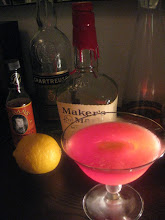
The Old #152 Cocktail - a Kentucky Derby Cocktail

Named for the Official Steam Engine of the Commonwealth of Kentucky, the Old #152 is my entry into the Eleven Madison Park/Maker's Mark Kentucky Derby Cocktail Challenge.
I wanted to create a light but complex drink to highlight the season. Sticking to the "Official State Things" concept I wanted to build the drink around blackberries (the official State fruit of both Kentucky and Alabama). The recipe is below.
EMP "received many impressive recipes from some of the top mixologists in New York and the tremendous number of high caliber submissions did not make this an easy decision." So...As somewhat expected even beforehand....I didn't make it to the finals. Still, I had a lot of fun putting it together and I'm proud of my end product.
The Old #152 Cocktail
--------------------------
2.0 oz. Maker's Mark Kentucky Straight Bourbon Whiskey
1.0 oz. Fresh Lemon Juice
0.5 oz. Herbes de Provence Syrup *
1 tsp Blackberry preserves **
2 barspoons Green Chartreuse
2 Dashes Regans' Orange Bitters No. 6
Combine all ingredients and shake with ice. Strain through a mesh sieve to remove blackberry seeds into a chilled cocktail glass. Garnish with a twist of lemon (and a blackberry if available/seasonal).
--------------------------
* For the syrup: Combine 1 cup of water and 1 cup of granulated white sugar in a pan. Bring just to a boil. Remove from heat and add hot syrup to 6 Tbsp. Herbes de Provence. Steep overnight. Strain. Store in refrigerator.
** A high quality/ primarily Blackberry preserve is best. I use Agrimontana More from Italy. If the preserves have a lot of seeds, like the Agrimontana, light muddling is recommended before shaking.
Subscribe to:
Comments (Atom)